
- Trust in the results of banking AI depends heavily on the use case
- Some 46% of respondents identify AI errors as the greatest risk, followed by data protection concerns
- More than two-thirds of respondents expect banks to be transparent and disclose their ethical principles when using AI
Trust in AI comes with reservations: Consumers value AI for fraud detection but prefer human involvement in lending decisions. Whether AI is accepted or rejected in banking therefore depends crucially on what it is used for. This is shown by the current EOS Banking AI Barometer. As part of this representative study, people in eleven European countries were surveyed about their attitudes towards the use of AI by banks.
Which tasks do people trust AI with most in banking?
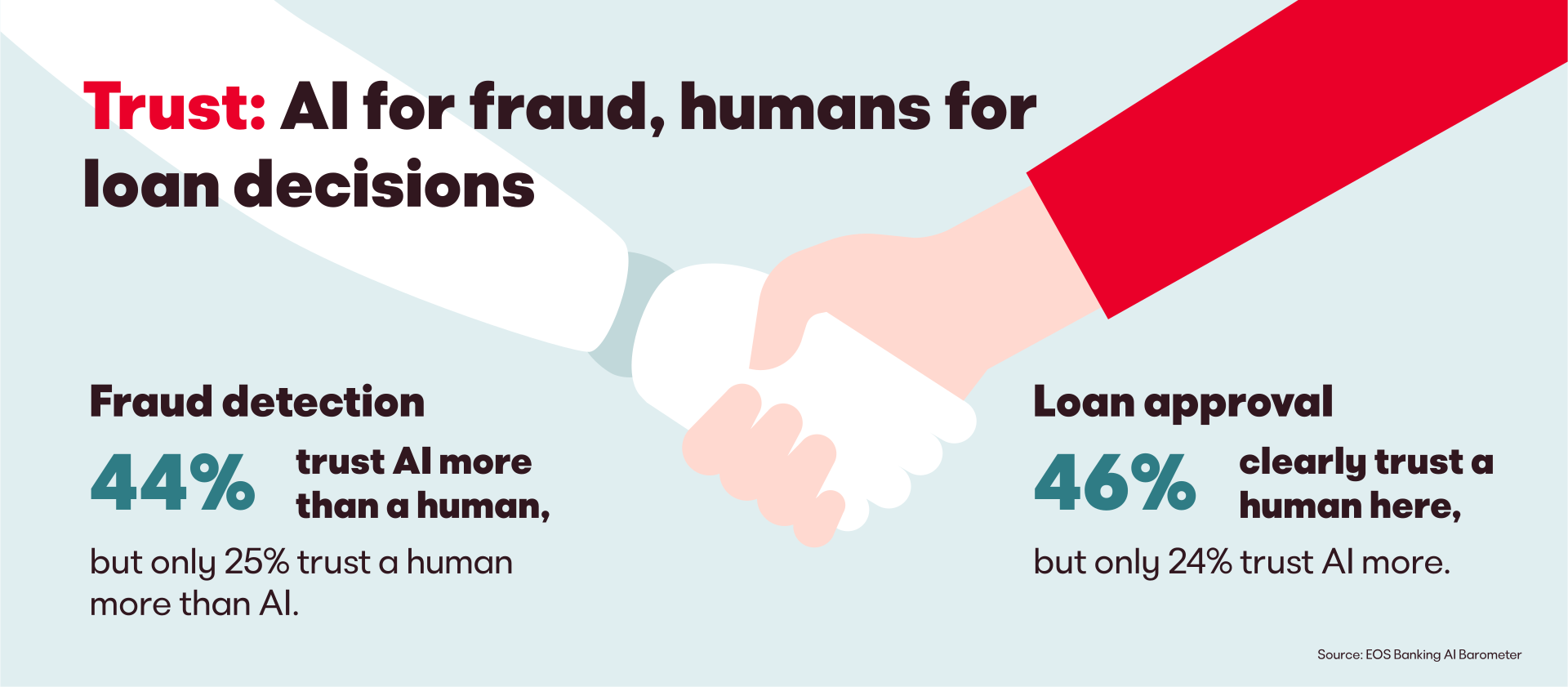
Trust in AI is particularly high when it comes to security. Some 44 percent of respondents trust AI more than a bank employee when it comes to identifying suspicious transactions. “AI has demonstrated its strengths in fraud prevention: It can analyze large amounts of data and identify patterns. In other areas, this capability is less obvious to consumers,” explains Janusch Skubatz, Chief Information Security Officer of the EOS Group.
Which task are bank customers most reluctant to entrust to AI?
When it comes to personal financial decisions with far-reaching consequences, human judgement remains highly valued. The greater the role of individual circumstances and personal consequences, the stronger the desire for human involvement. When it comes to loan decisions, 46 percent of consumers trust a bank employee, compared with just 24 percent who trust AI. Human involvement appears to remain important, particularly when major financial decisions are involved. This could give traditional branch-based banks an advantage over neobanks, particularly when it comes to important financial decisions.

The results clearly show that trust in AI does not arise automatically. Companies need to establish a binding framework and communicate it transparently.
EOS sees a similar preference for human involvement, particularly in more complex cases involving people with outstanding debts. Many concerns can be conveniently addressed digitally via the service portal. However, in more complex cases, direct contact by phone or email can make a difference. That is why EOS offers a variety of communication channels, allowing everyone to choose the right way to get in touch.
What do customers fear when banks use AI?
Almost half of respondents see errors or incorrect decisions as the greatest risk when AI is used in banking. Data protection concerns rank second. A lack of empathy is also a concern, with 28 percent of respondents identifying it as a disadvantage. Only five percent of respondents see no risks at all in the use of AI.
How can banks build trust in the use of AI?
Transparency is a key factor in building trust. More than three-quarters of respondents expect banks to disclose when and how they use AI, and 80 percent expect financial institutions to provide clear information about the guidelines and ethical principles governing their use of AI.
Consumers therefore do not trust AI unconditionally. Their trust depends on understandable processes, clear responsibilities, and transparency about the opportunities and risks associated with the technology. Organizations using AI need to be able to explain how it works and what rules govern its use. Technical performance alone is not enough to gain consumer acceptance. Successful AI adoption is therefore not only a technical challenge but increasingly a question of trust.
What do European consumers think about AI in banking?
For the study EOS Banking AI Barometer – How Europe really feels about AI in banking, 4,400 people in the eleven European countries of Bulgaria, Croatia, France, Germany, Greece, Poland, Portugal, Romania, Slovenia, Spain, and Switzerland, with 400 respondents per country, were surveyed about their attitudes toward artificial intelligence in bank communications. The data was collected in July 2026, and the target group consisted of bank customers aged 18 to 65. The study was conducted online based on a representative sample of the population.
Would you like to find out more about the current EOS study? Please feel free to contact us.

Carina Bonde
Corporate Communications & Marketing
Phone: + 49 173 2979331
Explore more from EOS